
Mapping rights · Documenting lives
Country profile
Morocco criminalizes consensual same-sex acts under Article 489 of the Penal Code — a provision enacted in the post-independence code of 1962 — with penalties of six months to three years’ imprisonment and a fine. The law applies to both men and women, and is enforced selectively: prosecutions are frequently triggered by online exposure, morality complaints, or moments of public visibility rather than by routine policing. Between 2017 and 2020 alone, 838 people were prosecuted under Article 489.
Morocco has a notable domestic history of queer publishing and organizing — independent magazines, community collectives, and broad campaigns for individual liberties — even though no LGBTQI+ association has ever obtained legal registration inside the country. Civic space has tightened further under recent measures such as Law 03-23 (2025). There is no recognition of same-sex relationships, no anti-discrimination protection, and no pathway to legal gender recognition.
The law
Article 489 of the Moroccan Penal Code, enacted in the code promulgated in 1962 shortly after independence, criminalizes “lewd or unnatural acts with an individual of the same sex.” The provision carries six months to three years’ imprisonment and a fine of 200 to 1,000 dirhams. Unlike provisions framed solely around a single act, Article 489 applies on its face to same-sex conduct between any two people, and prosecutions of women have been documented alongside those of men.
Article 489 is reinforced by a cluster of morality provisions. Article 483 (public indecency) is frequently charged alongside or independently of Article 489, particularly against gender-nonconforming people and trans women, while Articles 490–493 criminalize sexual relations between unmarried people of different sexes. Because the law turns on loosely defined “acts” rather than identity, it grants enforcement authorities unusually wide discretion over what may count as evidence.
“Lewd or unnatural acts with an individual of the same sex” — 6 months to 3 years’ imprisonment and a fine of 200–1,000 dirhams. Applies to both men and women. Art. 483 — public indecency (frequently charged alongside). Arts. 490–493 — extramarital sex between different-sex partners (1 month to 1 year).
Evidence & fair-trial concerns
The most consistently documented abuse in Moroccan enforcement is conviction on the basis of confessions that defendants later repudiate as coerced or falsified. Courts have upheld convictions resting solely on police statements, without witnesses or corroborating evidence, and without investigating claims that signatures were obtained under threat. Increasingly, the contents of phones and same-sex dating applications — and, for trans people, clothing and appearance — are treated as proof of an offence.
Criminalizing consensual same-sex relations between adults violates the right to privacy guaranteed by the International Covenant on Civil and Political Rights, which Morocco ratified in 1979; arrests on this basis amount to arbitrary detention. — UN human-rights mechanisms
A state-appointed human-rights institution recommended in 2019 that consensual relations between unmarried adults be decriminalized; the government rejected the recommendation. In 2024, the Justice Minister announced a penal-code reform process oriented toward decriminalizing private extramarital relations, but made no commitment to repeal Article 489.
Documented cases
Six men were convicted under Article 489 after a video of a private party circulated online and was described in the press as a “gay wedding.” According to defence lawyers, the prosecution presented no evidence that the men had engaged in the prohibited conduct. The arrests were followed by street demonstrations demanding their punishment.
An appeals court upheld Article 489 convictions based solely on statements the defendants had made in police custody and repudiated at trial. The court called no witnesses and reviewed no other evidence, and all defendants denied the charges in court.
Two teenage girls were prosecuted under Article 489 after a relative photographed them embracing and reported them to police. The case drew international attention, and the minors were freed — illustrating that the provision reaches women and is triggered by private, non-consensually circulated images.
Prosecution data
A 2022 submission to the UN Universal Periodic Review documented 838 prosecutions under Article 489 between 2017 and 2020, with annual figures rising before the pandemic (130 in 2017, 147 in 2018, 168 in 2019, 141 in 2020). The public prosecutor’s office reported that 170 adults were charged with same-sex relations in 2018. Independent monitors note these figures capture only documented cases and substantially undercount the real total, as most prosecutions go unreported due to stigma.
The 2011 constitution
Morocco’s current constitution was adopted by referendum in 2011, amid the protest wave of the February 20 Movement, and presented as a reforming text. It guarantees equality before the law, protects the right to private life and the confidentiality of personal communications (Article 24), and guarantees the freedoms of association, assembly and peaceful protest (Article 29). It also establishes Islam as the religion of the state, with the King as Commander of the Faithful (Amir al-Mu’minin), and creates a Constitutional Court.
The text contains no reference to sexual orientation or gender identity. Its anti-discrimination language enumerates protected grounds — sex, colour, belief, culture, social or regional origin, language and disability — that do not include SOGI. Its equality provisions, including the guarantee of equality between women and men (Article 19), are expressly qualified by respect for the “constants of the Kingdom” (Islam, the monarchy, territorial integrity), which operate as a ceiling on how far guaranteed rights can be read to extend.
Guarantees on paper, exposure in practice
For LGBTQI+ people the central contradiction is the right to private life. Enforcement of Article 489 depends almost entirely on intrusions into precisely that sphere — the seizure and search of phones, the reading of private messages, and prosecutions built on leaked or non-consensually circulated images. The same constitution that guarantees privacy coexists with a penal code that punishes consensual conduct in private.
- No SOGI protection in the equality or anti-discrimination provisions
- Equality guarantees qualified by the “constants of the Kingdom”
- The right to private life routinely overridden in Article 489 enforcement
- Freedom of association guaranteed in the text but conditioned in practice on Ministry of Interior approval — repeatedly denied to LGBTQI+ groups
- A weak and dependent judiciary, leaving constitutional rights difficult to invoke against the penal code
No constitutional avenue has been successfully used to challenge the criminalisation of same-sex conduct. Where guaranteed rights collide with the penal code or with the “constants,” the rights have remained, for LGBTQI+ people, largely aspirational.
Moroccan law provides no anti-discrimination protections based on sexual orientation or gender identity in employment, housing, education, or healthcare. Law 103-13 on combating violence against women, in force since 2018, was a milestone for women’s-rights advocacy, but it frames violence around gender-based discrimination against women and includes neither recognition of SOGI-based violence nor protection for LGBTQI+ women. The constitutional body tasked with combating discrimination does not address SOGI, and human-rights monitors have criticised the law for treating rape through the lens of morality and public decency rather than bodily autonomy.
Hate crimes
No hate-crime framework exists for SOGI-based violence in Morocco. Violence against LGBTQI+ people — including assault, family violence, “corrective” violence, and filmed mob attacks — is prosecuted, if at all, under general criminal provisions, with no recognition of discriminatory motivation. Documented prevalence is high: surveys submitted to the UN in 2022 found that 70% of LGBTI respondents had experienced violence, rising to 82% among non-binary and gender-non-conforming people and 86.5% among trans women.
Reporting & hate speech
The decisive barrier is that reporting violence exposes the victim to prosecution. Because Article 489 criminalises the victim, LGBTQI+ people are widely treated as people who cannot safely approach the authorities — making them, in the words of civil-society documentation, easy targets whose attackers act with effective impunity. There is no protection against SOGI-targeted hate speech: the 2020 online campaign that circulated photographs, names, and threats against gay and bisexual men produced no legal recourse for those exposed.
Healthcare access
There is no SOGI-affirming provision within the public health system, and no recognised pathway to gender-affirming care. Trans people are particularly excluded, with identity documents that do not match their presentation severing access to services. Mental-health and psychosocial support is largely unavailable publicly and reaches LGBTQI+ people, where it does at all, through informal community networks operating without legal cover.
Same-sex relationships are not legally recognised in Morocco. The Family Code (Moudawana), first codified in 1958 and reformed in 2004 and 2024, is grounded in Maliki Islamic jurisprudence and defines marriage as a union between a man and a woman. There is no civil union or domestic partnership framework. Relationships outside marriage are themselves criminalised under Article 490, so non-marital intimacy carries legal risk regardless of orientation.
The 2024 Family Code reform
In December 2024, after a royal directive and more than a year of consultations, the government unveiled a wide-ranging reform of the Moudawana — updating rules on marriage, divorce, custody and inheritance, recognising domestic labour, and tightening polygamy without abolishing it. The reform left untouched the questions most relevant to LGBTQI+ people: it made no provision for same-sex relationships, declined to recognise children born outside marriage, and retained the criminalisation of extramarital relations.
The decriminalisation of consensual relations remained outside the reform’s scope. A state-appointed human-rights body had recommended in 2019 that consensual relations between unmarried adults be decriminalised, and in 2024 the Justice Minister spoke of moving toward decriminalising private extramarital conduct — but neither initiative was enacted, and neither extended to repealing Article 489. No official body has recommended recognising same-sex relationships.
Adoption & guardianship
Moroccan law does not provide for adoption in the sense of severing and replacing a child’s lineage, which is prohibited under the Islamic-law framework the Family Code follows. In its place, the law recognises kafala — a form of legal guardianship that confers care without filiation. Kafala is restricted to Muslim applicants and, in practice, to married couples or single individuals; same-sex couples have no route to joint guardianship, and criminalisation excludes openly LGBTQI+ people from the process altogether.
Morocco provides no legal gender recognition for transgender people. The civil-status framework treats sex as fixed and binary, and there is no administrative or judicial process to change a name or the sex marker on official documents to reflect gender identity. Trans people are therefore unable to hold documents matching who they are, with severe consequences across employment, travel, healthcare, and every encounter with the authorities.
Trans people and criminalisation
Trans people — particularly trans women — face de facto criminalisation under Article 489 and public-decency provisions (Article 483), with appearance itself — clothing, make-up, the way a person moves through public space — treated as evidence. Documentation describes trans women subjected to arbitrary arrest, the confiscation of identity documents, the non-consensual publication of their names and faces, and the severing of access to employment and housing. Trans women report among the highest rates of violence recorded in surveys submitted to the UN in 2022 — 86.5% — and for many, leaving the country becomes the only available exit.
Intersex people
Morocco has no legal framework protecting the rights or bodily autonomy of intersex people. Non-consensual medical interventions on intersex children to “normalise” sex characteristics are unregulated, without any requirement of consent or independent oversight. Intersex issues remain almost entirely absent from law, public debate, and organised advocacy.
A civil society without legal standing
No LGBTQI+ organisation has ever obtained legal registration in Morocco. Associations are governed by the 1958 decree on the right of association, under which a group acquires legal existence by filing a declaration and receiving an official receipt (récépissé) from the authorities. In practice, the authorities simply withhold that receipt from organisations working on sexual orientation and gender identity. A clause of the decree barring associations whose purposes are deemed contrary to public morals, the Islamic religion, or the monarchical order gives officials a broad, vaguely worded basis for refusal.
The registration wall
The first group of its kind, founded in 2004, applied repeatedly for legal status and was refused each time; by 2008 it had relocated its operations abroad in order to function at all. A community organisation that has sought registration since December 2016 has been consistently denied. No Moroccan court has ever recognised the legal existence of an LGBTQI+ association — there is no founding precedent to build on, only a standing wall of administrative refusal.
A tightening civic space
The wider environment for civil society has narrowed. Independent monitoring in 2024 documented routine denial of registration to organisations defending marginalised communities, alongside surveillance and obstruction of their ability to rent venues or hold bank accounts. Law 03-23 (adopted 2024, published 2025) further restricted civil society’s standing to bring certain legal actions. In late 2025, the decentralised GenZ 212 protest movement mobilised young people across the country; although its demands did not include LGBTQI+ rights, queer and feminist activists who took part reported being specifically targeted, with police accessing their phones to build criminal cases.
Expression & visibility
No Pride march or public queer cultural event is possible; any attempt would invite arrest. The state has banned books addressing homosexuality and has periodically moved to tighten control of online speech, including a 2020 social-media bill — withdrawn after public outcry — that would have criminalised a wide range of online expression. Online space is monitored, and the 2020 outing campaign showed how quickly it can be turned against LGBTQI+ people. Much of Morocco’s most visible queer expression is sustained from the diaspora and in semi-clandestine community spaces.
Moroccan LGBTQI+ asylum seekers abroad
France, Spain, Belgium, Germany and the Netherlands are among the principal destinations for LGBTQI+ Moroccans seeking asylum. European systems recognise them as members of a particular social group (PSG) — one of the grounds for protection under refugee law — on the basis of criminalisation, family rejection, and the absence of any state protection.
Because no LGBTQI+ association is legally registered inside Morocco, asylum seekers cannot obtain the support letters that an in-country organisation might otherwise provide. Credibility assessments therefore lean on documented country-of-origin evidence — Article 489, the prosecution figures, the 2020 online outing campaign, and submissions to UN review — together with the assistance of diaspora-based support networks.
A weak domestic asylum system
Morocco is party to the 1951 Refugee Convention and its 1967 Protocol, and has also ratified the regional refugee convention of the Organisation of African Unity. A 1957 royal decree created a refugee office, reactivated in 2013 alongside a national immigration-and-asylum strategy. Yet a national asylum law drafted more than a decade ago has never been adopted, there is no way to lodge an asylum claim at the border, and in practice the UN refugee agency conducts refugee status determination. For LGBTQI+ people, seeking protection inside a country that criminalises them is rarely a realistic option.
A transit country
Morocco is also a major transit point for migrants and asylum seekers from sub-Saharan Africa attempting to reach Europe. LGBTQI+ people within these movements face compounded vulnerability — criminalisation, racism, and exposure to violence at the borders, including the deadly events at the Melilla crossing in 2022. The absence of a functioning asylum system leaves them with little formal protection.
Morocco ratified the International Covenant on Civil and Political Rights in 1979 and is bound by the principal human-rights treaties. Civil-society coalitions have submitted shadow reports to successive Universal Periodic Review cycles and to treaty bodies, documenting the enforcement of Article 489 and its effects — most extensively for the 2022 review, which carried detailed prosecution figures for 2017–2020. UN human-rights mechanisms have repeatedly held that criminalising consensual same-sex conduct violates the rights to privacy and non-discrimination.
In 2019 a state-appointed human-rights body recommended decriminalising consensual relations between unmarried adults, explicitly engaging international standards; the government rejected it. Across review cycles Morocco has consistently declined recommendations to repeal Article 489, defending the provision on grounds of national and religious identity — a posture underscored when a senior official publicly disparaged LGBTI people immediately after a Geneva review.
| Mechanism / Year | Recommendation or outcome | State response |
|---|---|---|
| 1979 — ICCPR ratified | Binds Morocco to privacy & non-discrimination | Article 489 retained |
| 2008 — UPR Cycle 1 | Decriminalisation raised by several states | Noted — no action |
| 2012 — UPR Cycle 2 | SOGI recommendations | Noted |
| 2016 — ICCPR Human Rights Committee | Repeal of Arts. 489 & 490 urged | No action |
| 2017 — UPR Cycle 3 | Decriminalisation recommended; civil-society shadow report | Rejected; official disparaged LGBTI people after Geneva |
| 2017 — UN special procedures | Criminalisation of extramarital relations questioned | No substantive response |
| 2019 — National human-rights body | Recommended decriminalising consensual extramarital relations | Rejected by government |
| 2019 — Council of Europe (PACE) | Urged halt to enforcement of Art. 489 & extramarital provisions | No change |
| 2022 — UPR Cycle 4 | Shadow report documents 838 prosecutions; states recommend repeal of Art. 489 | Decriminalisation recommendations not accepted |
| 2022 — CEDAW submission | Impact of criminalisation on lesbian & bisexual women raised | Limited response |
Archives of a Movement
A glimpse, not a full picture
This is in no way an exhaustive list of the collectives and initiatives at work across the country. It offers a glimpse of the dedication and consistency that queer organizing has sustained here over the past decades — work carried out, often quietly and at real risk, by far more groups and individuals than any single archive could hold.
If your collective or initiative would like to be part of Carto-Queer NA, we would be glad to hear from you. Reach out, and help us keep this record growing.
Get in touch→About the magazine
Mithly (mithly.net) was a magazine dedicated to the gay, lesbian, bisexual and transgender community in Morocco and the wider Arab world. It set out to keep a record of the everyday challenges, joys and fears of people belonging to these communities — a record it considered invaluable for understanding both how its members identify with one another and what they sought as a community living in one of the most socially and politically turbulent regions in the world. Mithly placed a high value on self-expression in any form, hoping to serve at once as a guide and a listener for everyone who visited, and circulated its articles in several languages so as to leave no one out.
The name
"Mithly" (مثلي) is the Arabic word for "gay." The magazine chose the name deliberately, as part of its aim to give voice to Moroccan LGBT people. Its editors framed homophobia as something rooted in a lack of knowledge — fear of an unknown — and saw the magazine's pages as a way to offer a glimpse, however brief, into the lives and thoughts of the community, in the belief that being understood is a step toward being recognized, accepted and included.
Origins
Mithly was launched by the organization KifKif in April 2010 and is generally described as the first LGBT magazine in Morocco — and in the Arab world. Funded by KifKif and the European Union, its first print edition (around 200 copies) was distributed clandestinely, as the magazine had not been granted the legal permission required to publish; an online edition accompanied it.
Publications & resources
Archiving note: NACSP does not own any of this material and claims no rights over it. Mithly and all its content belong to their original creators. These files are mirrored here solely as part of our archiving and preservation efforts, to keep this community work accessible. If you are a rights holder and would like a file removed, please contact us.
About the magazine
Aswat ("voices" in Arabic) is a queer libertarian magazine from Morocco. It first appeared in the early 2010s as a monthly, downloadable publication, releasing 24 issues before pausing in December 2014 while its team turned toward other forms of queer activist work. It later relaunched with a renewed editorial philosophy and a new visual identity, moving from a monthly download to new content published daily, directly on its website.
The name & the inverted triangle
"Aswat" means "voices." The magazine's wordmark carries the title in Arabic, Tamazight and English, and its emblem is an inverted triangle bearing the first letter of the name in each of the three scripts. The inverted pink triangle was a badge used in Nazi concentration camps to mark people imprisoned for homosexuality; the magazine reclaims it as a reminder of the persecution — imprisonment and killing — of people targeted on the basis of their sexual orientation, a reality it describes as still ongoing in Morocco, the SWANA region and beyond.
Editorial vision
The magazine frames its work around the intersectionality of struggles and the interconnection of social movements. It commits to dedicating substantial space to women and trans people, and to ending their marginalization within its coverage of LGBTQI+ issues, as well as to imagining alternative futures for these struggles beyond Euro-centric models.
Aswat relaunched against a backdrop of continued criminalisation — Article 489 of the Moroccan Penal Code — and intensifying violence against LGBTQI+ people, alongside an unprecedented wave of community mobilization and legal defence.
Publications & resources
Links & contact
Archiving note: NACSP does not own any of this material and claims no rights over it. Aswat and all its publications belong to their original creators. These files are mirrored here solely as part of our archiving and preservation efforts, to keep this community work accessible. If you are a rights holder and would like a file removed, please contact us.
About the organization
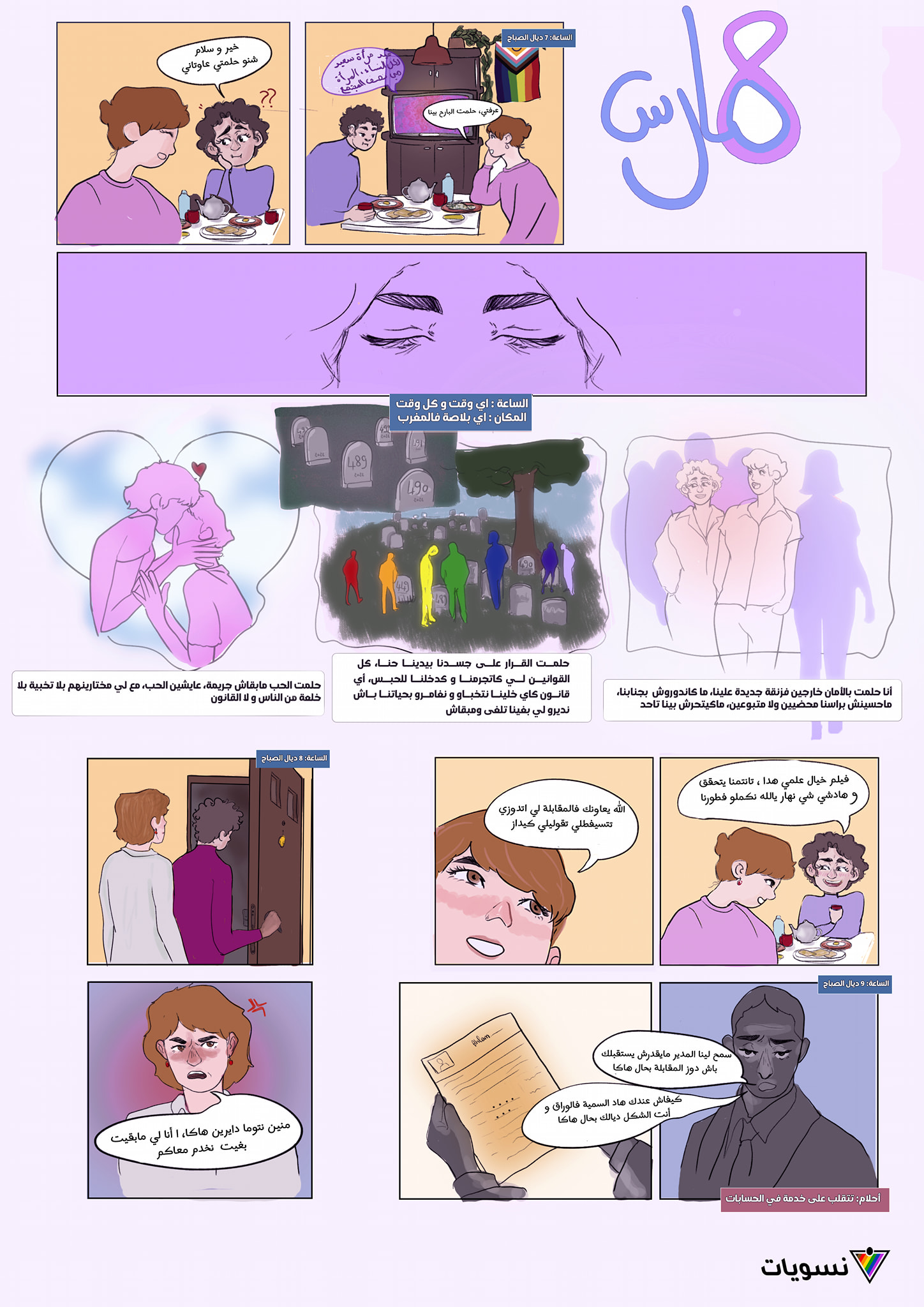
Nassawiyat ("feminists" in Arabic) is an LBTQ womxn* and feminist group based in Morocco. It was established to peacefully combat all forms of violence and discrimination — based on sexual orientation and gender identity or expression — directed at marginalized communities in the country.
Womxn*: in the group's own usage, anyone who identifies as a woman — including cis women, queer women and trans women — as well as trans, non-binary and gender-nonconforming people.
Vision
The organization works toward a Moroccan society in which the human rights of all people — sexual, bodily, social, political, civil and cultural — are recognized, respected and promoted.
Mission
Nassawiyat advocates for the human rights of LGBTQI+ people in Morocco by creating and maintaining safe, inclusive and equitable spaces for the community. It also encourages and supports community members in being visible and in expressing their voices freely and without fear — through artivism, campaigning and knowledge production.
Values
The group takes an intersectional, feminist approach to its work and tools, in order to fight all forms of oppression, which it understands as interconnected. It recognizes that sexual orientation and gender identity or expression are connected to, and influenced by, race and ethnicity, gender, culture, age, ability status, class, faith and other social characteristics. Nassawiyat is committed to advancing equality so that all people may live in dignity and respect.
Homouna — web series
Homouna ("they/them" in Moroccan darija) is a web series produced by the group, in darija, exploring the lives, challenges and dreams of queer, bi and trans women and non-binary people in Morocco and the diaspora. It draws on the true stories of LBTQ women whom the group's members met and interviewed.
Publications & resources
Links & contact
Archiving note: NACSP does not own any of this material and claims no rights over it. Nassawiyat and all its publications belong to their original creators. These files are mirrored here solely as part of our archiving and preservation efforts, to keep this community work accessible. If you are a rights holder and would like a file removed, please contact us.
About the collective
Elille is an independent Moroccan collective dedicated to inclusion, social diversity and gender equality. It began in 2019 and was officially founded in May 2020, growing out of a simple but deeply held wish: to create a space in which every voice, every identity and every difference would have its place. The collective brings together activists, artists and artivists who share the conviction that art, culture and critical reflection are powerful levers for transforming society. Through its work, Elille seeks to build bridges, give visibility to those who are not heard enough, and inspire real change toward greater justice and equity.
Mission & objective
Elille's mission is to make culture, the arts and media a tool for promoting inclusion and social diversity. Its main objective is to create, produce and circulate artistic and cultural projects that challenge inequality and celebrate equality and equity.
Actions
The collective's work takes shape through three main lines of action:
- Producing alternative media content that gives a platform to those who are not heard enough.
- Creating artistic and cultural projects that tell and amplify the struggles for inclusion and equality.
- Developing innovative initiatives to strengthen social justice and diversity.
Vision
A world where everyone has their place, free from discrimination based on gender, class, race or any other form of inequality.
Values
Projects
Archiving note: NACSP does not own any of this material and claims no rights over it. Elille and all its publications belong to their original creators. These files and links are referenced here solely as part of our archiving and preservation efforts, to keep this community work accessible. If you are a rights holder and would like an item removed, please contact us.